A few things worth your attention.
Thoughts, signals, conversations, and tools to help you see your business more clearly.
Things worth knowing.
The Leaves Are Fine
LinkedIn asked a web designer if he needed to hire a web designer. That is not a glitch. It tells you something about every tool you are paying to work on your behalf.
You Should Not Have to Plan Your Own Website
Why the owner is the last person who should be designing the navigation.
When Referrals Quietly Stop Working
Referrals don't disappear overnight. They thin out slowly, then suddenly.
The Cost of Being the Only One Who Knows
When every question comes to you, you are the bottleneck. That's a structural problem.
Busy Is Not the Same as Discoverable
A full schedule can hide a fragile business. Here's what to look for.
What Other Owners Are Seeing
Signals showing up across similar businesses.
Questions Showing Up Repeatedly
If your customers keep asking it, it belongs on your site.
Patterns Worth Watching
Trends that tend to reach local service businesses last.
What makes a business valuable.
- What buyers look for
- What makes it transferable
- What reduces it silently
Conversations for owners.
Why the Phone Keeps Ringing at the Wrong Time
A question worth sorting.
Pick it up →
Short pieces for owners who are running the business and trying to improve it at the same time.
The Leaves Are Fine
LinkedIn asked a web designer if he needed to hire a web designer. That is not a glitch. It tells you something about every tool you are paying to work on your behalf.
Read →You Should Not Have to Plan Your Own Website
Why asking an owner to design their own site is the wrong question — and what a better process looks like.
Read →How Hard is it To Do Business With You
One company was closed and available. The other was open and unavailable. The real competitor isn't another company — it's the effort required to do business with you.
Read →An AI Assistant Needs More Than Your Business Information
Handing an AI assistant your website and documents paints a picture of your business — but it doesn't give it a soul. What a Constitution actually protects.
Read →The Cost of Being the Only One Who Knows
When all the knowledge lives in the owner's head, the business can't grow, can't rest, and can't be handed off.
In progress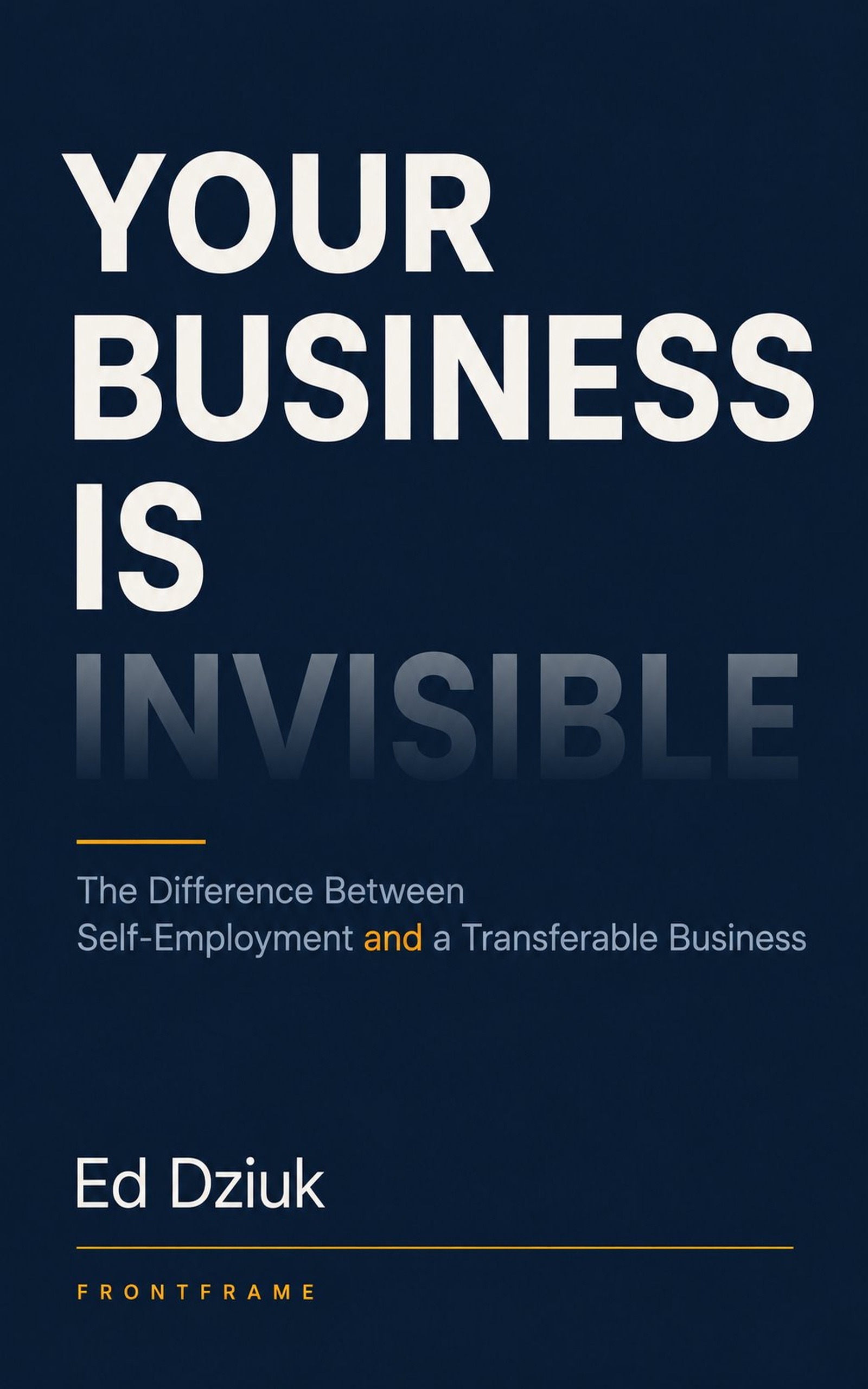
Your Business Is Invisible
A short book about why some businesses become easier to run, easier to grow, and eventually easier to hand off — and what separates them from ones that don't.
Most service businesses are built entirely around their owner. That's usually how they start. This book is about what happens next — and what it takes to build something that works without you at the center of everything.
Patterns showing up across local service businesses. What owners in similar verticals are running into, what questions keep surfacing, and what shifts tend to reach small businesses last. Advisor Intel is available deeper in the drawers for those who work with owners professionally.
The businesses that recognize themselves.
Stories from the verticals we serve — in audio and in print. Every owner who hears them will know someone who lived them.
Loading episodes…
More conversations coming.
Stories from pet sitters, bookkeepers, cleaners, tutors, handymen, photographers, and similar owner-operators. The situations change. The patterns don't.
Ed DziukFounder, FrontFrame
Recorded conversations with owners and the people who work alongside them. On visibility, on workload, on what makes a local business easier to run.
When Smart People Agree
One of the dangers of listening to smart people is that they are often right.
When Bill Ackman observes that the probability of disruption has increased enormously, most of us incorporate that idea into our worldview without much resistance. He manages billions of dollars, studies businesses for a living, and has forgotten more about capital allocation than most of us will ever know. If someone like Ackman says that technological change has made businesses more vulnerable, there is a good chance he is seeing something important.
He is probably right.
The same tools that make it easier to build a company make it easier to challenge one. Computing power is available to almost anyone. Capital is more accessible than it has ever been. Small teams can accomplish things that once required entire departments. Barriers that protected businesses for generations continue to fall, and there is little reason to believe that process will slow down.
What interests me, however, is not Ackman's observation. It is the conclusion most people draw from it.
The moment someone says disruption is becoming easier, the conversation shifts toward defense. Which competitors should we fear? Which technologies should we monitor? Which industries are vulnerable? Everyone begins looking for the threat.
That reaction is understandable, but I wonder whether it obscures the more interesting implication.
Every major technological shift destroys advantages. The railroad changed distribution. The automobile changed geography. The internet changed information. Artificial intelligence is changing the economics of knowledge work. Looking backward, the pattern is obvious. What is less obvious is that whenever one advantage disappears, another quietly takes its place.
When information became abundant, information itself became less valuable. The advantage moved to judgment. When websites became easy to build, websites ceased to be the advantage. The advantage moved to understanding customers. When software became easier to create and deploy, software itself became less valuable than understanding the problem it was intended to solve.
Value rarely disappears.
It migrates.
That is why I find myself asking a different question. If disruption has become easier, what exactly has become harder to disrupt?
Certainly not software. Computing power commoditizes that. Not websites, content, or automated processes. Not access to capital, talent, or information. These things are becoming increasingly available to anyone willing to learn how to use them.
But try to disrupt trust earned over twenty years.
Try to replicate the judgment that comes from making hundreds of decisions and living with the consequences.
Try to build a deep understanding of a market you have never served.
Try to earn a reputation that causes customers to seek you out before they seek alternatives.
These things operate on a different timetable. They cannot be rushed, rented, or downloaded. They must be earned the slow way.
The more I think about disruption, the more it appears to destroy advantages that were vulnerable in the first place. Businesses built around access lose their position when access becomes abundant. Businesses built around technology lose their position when technology becomes commonplace. What survives are the advantages that become more valuable as everything else becomes easier.
Most business owners compete in the same games as their competitors. Same price pressures. Same feature races. Same technology battles. The entire market runs the same course and wonders why the pressure never eases.
The businesses I admire have chosen different games.
The local accountant whose clients call before making important decisions. The contractor whose customers wait months rather than hire someone else. The physician whose patients recommend her without being asked. The business owner who understands a market so thoroughly that competitors struggle to explain why customers remain loyal. None of these people are immune to disruption. They have simply built around things that are harder to disrupt.
That is why I keep returning to Ackman's observation. I think he is right. The probability of disruption has increased enormously. But I am uncertain about the conclusion most people draw from it.
When everyone gains access to the same tools, the advantage does not disappear. It moves.
The businesses that thrive are rarely the ones defending yesterday's advantages. They are the ones that recognize where the advantage has gone and quietly begin building there before everyone else arrives.
The question is not which businesses artificial intelligence will destroy.
The question is where the advantage has moved.
Archive
Earlier writing and reference material. This drawer fills as the body of work grows.
Templates
Working documents and frameworks for owners building operational clarity. Coming as the curriculum develops.
Case Studies
Owner stories, pattern examples, and before-and-after business profiles. In development.
Advisors & Tools
Nolan Baum, CBI — Certified Business Intermediary and author of Helping Clients Sell Their Businesses Successfully — will have material here for owners and advisors thinking about business value and transition. The Advisor Intel feed is also accessible here. Both are in development.
For advisors who work alongside owners
CPAs, attorneys, brokers, and coaches who work with local service businesses will find material here that is useful to share. Deeper resources — including the Advisor Intel feed — are in the drawers. If you want to talk about how FrontFrame fits your advisory practice, the notepad on the desk is a good place to start.